Thinking Inside and Outside The Box
Interview by Wayne Labs, Food Engineering Magazine.
Drum motors are well suited to food and beverage conveying applications where motors should be out of sight, safe and clean.
Driving a conveyor head roller with a drum motor, which features a motor and gear box within the roller housing, is not a new concept. For around 70 years, this design has addressed space utilization issues by incorporating all external components inside the drum. However, the design has lacked the electrical and mechanical efficiency that can contribute substantially to energy savings and has been known to present some seal integrity issues.
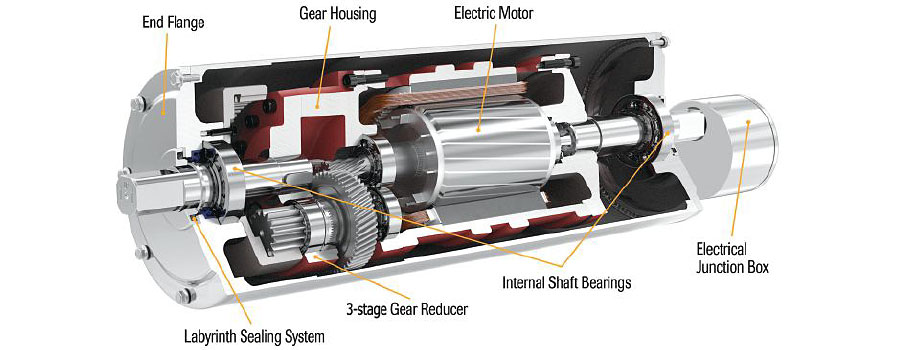
Today, the practical drum motor designs used in food processing plants protect all vital motor/gearing components within an IP69K stainless steel enclosure. These motors can withstand up to 3,000 psi of washdown pressure, without scheduled maintenance. Outside-the-box-thinking led to this improved design, with the motor, gear reducer and bearings inside the box, making it safer and more energy efficient. Plus, since no rotating components or pinch points are outside the conveyor frame, the drum motor conveyor drive protects personnel working around the equipment.
FE caught up with Alexander Kanaris, President of Van der Graaf, at FE’s recent Food Automation & Manufacturing Conference to find out about the latest developments in drum motor technology. Established in 1948 in the Netherlands, Van der Graaf began manufacturing drum motors in Toronto, Canada in 1985. Shortly afterward, it began operations in Shelby, MI. Over the years, the company’s North American manufacturing space has grown from 3,500 sq. ft. to over 200,000 sq. ft. Kanaris holds more than 25 patents.
Q: Tell us a little about yourself.
I have been involved in electromechanical designs and manufacturing since 1978. As an electrical engineer, I have specialized in electrical motor designs including three-phase, single-phase and DC motors, from fractional to 3,000 hp. In 1985, with the help and support of Mr. M. H. Van der Graaf of the Netherlands, I founded Van der Graaf in Toronto and, immediately after that, started designing and manufacturing drum motors. Many changes have occurred over the last 31 years. Not only has the design of the drum motor changed, the manufacturing process has involved using new technology, state-of-the-art CNC machinery including robotics, and automation.
Q: When did drum motors become applicable to the food industry?
The food industry was first targeted in 1985. By design, the drum motor addresses efficiency, maintenance and cost of ownership, but more important for the food industry, it also addresses sanitation. In standard conveyor designs, the washdown process tends to be more complicated and difficult to perform since the motor and gear box are exposed and have more crevices that can harbor bacteria. But, all the drive components of the drum motor are contained within a stainless steel cylinder, totally shielded from the external environment. So, it can withstand washdown pressures up to 3,000 psi.
Q: What design changes were necessary to make the drum motor suitable for food and beverage applications?
In the last decade, food processing companies have adopted many changes to address sanitation and worker safety, improve equipment efficiencies, lower operational costs and streamline conveyor designs for better space utilization. Belt manufacturers are addressing sanitation concerns by introducing new modular belt designs, as well as extruded belts, to minimize crevices that can harbor bacteria and to make the washdown cleaning process easier.
In the past, the IP57 enclosure was the accepted standard in the industry. Then, it became IP67. Now, the enclosure standard is IP69K. To keep up with ever-changing demands, Van der Graaf has made changes to the drum motor. For instance, we made substantial design changes to the drum, end flanges, shafts and electrical connection box to address new enclosure standards and minimize the possibility of water ingress. The chemical composition of the detergents and the washdown pressure used to sanitize conveyors also have changed. Consequently, Van der Graaf has designed a new labyrinth sealing system that can accept detergents with a pH range from two to 11.
And, to accommodate new modular and extruded positive-driven belts, Van der Graaf has undergone drum profile design changes, such as drive sprocket designs to drive modular belts from different belt manufacturers.