

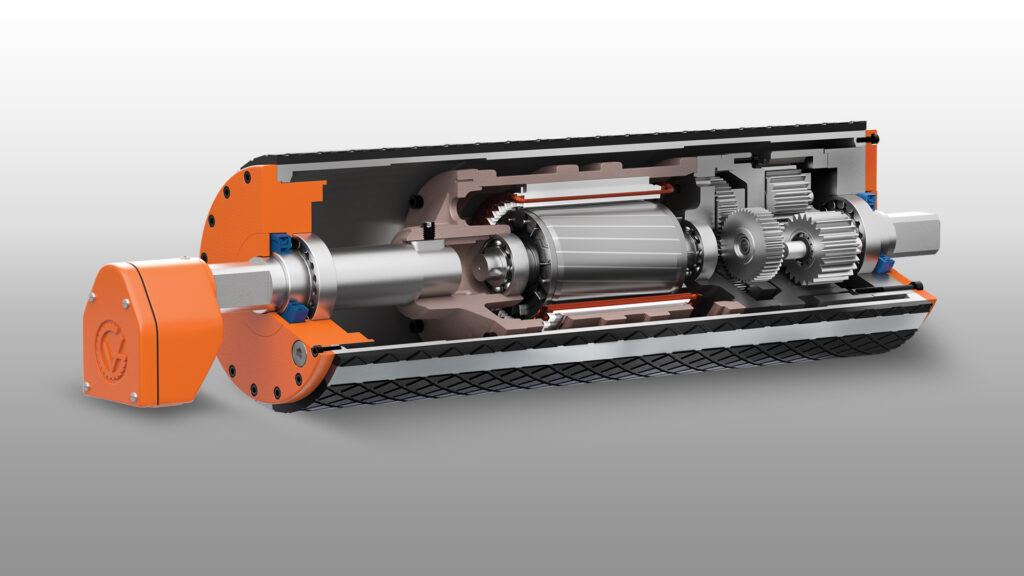
A New Generation of Reliable Drum Motors
Article by Alexander Kanaris, Founder and President of VDG (Van der Graaf).
The drum motor, used to power conveyor belts since the 1950s, operates safely and is often a space saver. But they haven’t gained traction with the belt conveyor industry because the internally powered conveyor drives tended to overheat. But that changed in mid-2021.
After a significant investment and five years of research and development, engineers uncovered the root cause of the heat issues, and developed a new generation of drum motors designed to operate continuously for 80,000 hours before requiring maintenance.
The drum motor is essentially a motorized pulley system, encapsulated within a steel shell — so there are no external rotating parts, a significant benefit compared to traditional external motor and gear box drives. They are designed to power belt conveyors utilized for a variety of applications including food processing and packaging lines, distribution center and postal operations, the aggregate and mining industries, to name just a few. In fact, you’ve probably experienced an airport baggage conveyer powered by a drum motor.
“How do drum motors work?”
The drum motor is a one-component conveyor belt drive. An input power cable passes through a hollow shaft, and is connected to the motor stator. The electric motor is mechanically connected in-line to the gear reducer.
The drum motor is partially filled with oil. The oil inside the drum motor lubricates all mechanical components and helps to dissipate heat generated by the electric motor and gear reducer onto the drum, and from the drum to the belt. In theory, the drum motor is cooled by the belt making full contact with the rotating steel drum.
“Why is the new drum motor design more reliable?”
With the motor and gear reducer in-line, the drum motor eliminates mechanical losses, as is often the case with traditional external motor and gearbox systems. The only mechanical losses are in the gear reducer itself, which is 2% per stage of reduction. The majority of gear reducers are two-stage, with some having three-stages depending on the desired belt speed. As a result, the mechanical losses of the drum motor may range between 4% and 6%, making it the most efficient belt drive on the market today.